
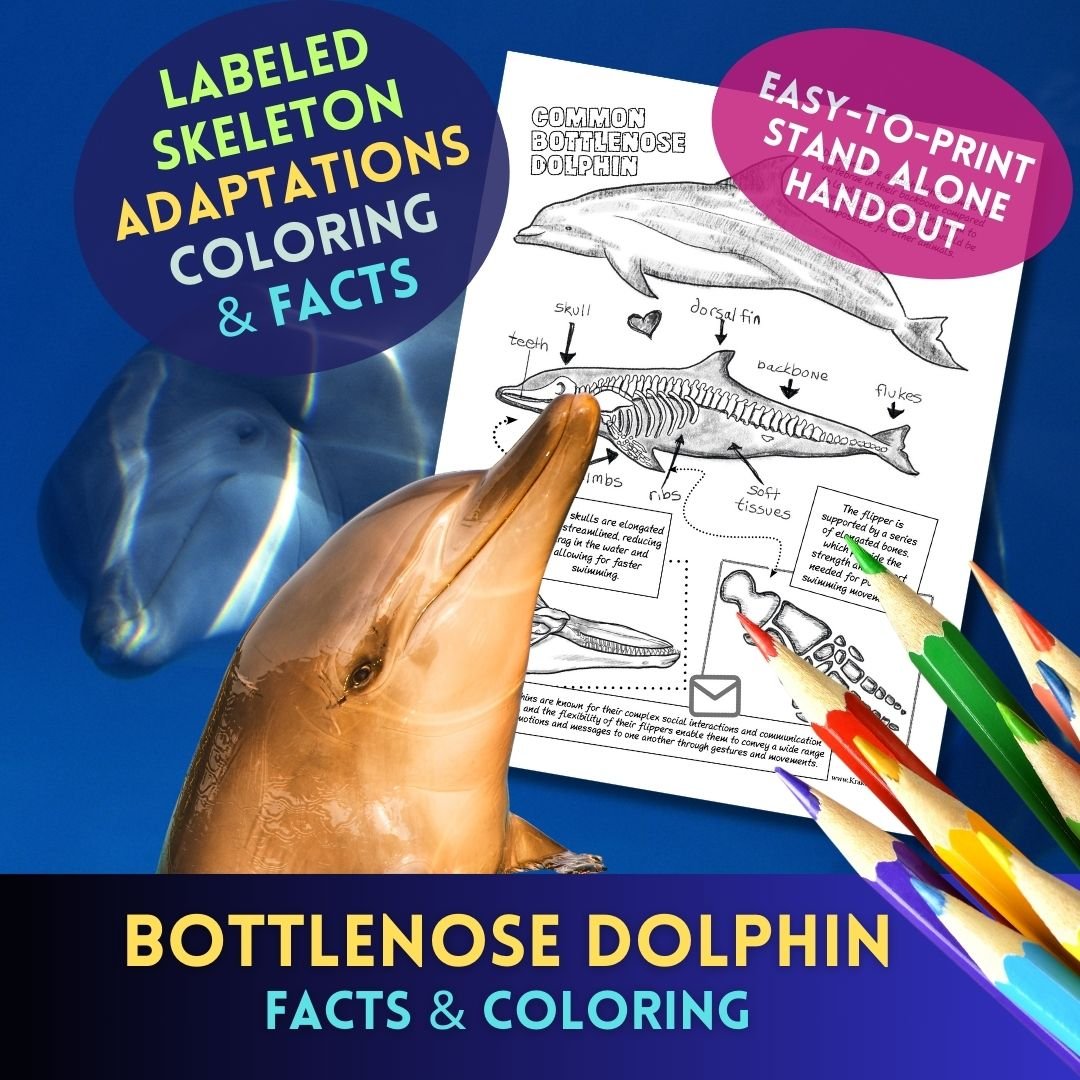
Bottlenose Dolphin - Skeleton and Physical Adaptations
Bottlenose Dolphin - Skeleton and Physical Adaptations
Perfect for Grades 3–6, this resource works for informational text practice, NGSS life science lessons, or environmental studies.
Students will explore fascinating facts about dolphin anatomy, adaptations, and behaviors, including:
• Unique skeletal features that allow greater flexibility and movement.
• Flipper structure and its role in powerful swimming.
• Social interactions and communication through body movements.
• Streamlined skull adaptations for speed in water.
This resource blends reading comprehension with life science content, making it ideal for ELA centers, science units, or cross-curricular lessons.
- Labeled Skeleton
- Physical attribute notes with a focus on their movement for communication
- Coloring areas
Standards Alignment
Common Core ELA (CCSS.ELA-LITERACY)
• RI.3.1 / RI.4.1 / RI.5.1 – Ask and answer questions to demonstrate understanding of informational text.
• RI.3.2 / RI.4.2 / RI.5.2 – Determine the main idea and explain how it is supported by key details.
• RI.3.4 / RI.4.4 / RI.5.4 – Determine the meaning of academic and domain-specific words.
• RI.3.7 / RI.4.7 / RI.5.7 – Use information from text and visuals to demonstrate understanding.
• W.3.2 / W.4.2 / W.5.2 – Write informative texts to convey information clearly.
Next Generation Science Standards (NGSS)
• 3-LS3-2 – Use evidence to support the explanation that traits can be influenced by the environment.
• 3-LS4-3 – Construct an argument that some animals survive well in particular habitats.
• 4-LS1-1 – Construct an argument that animals have internal and external structures that support survival, growth, and reproduction.
• 5-ESS3-1 – Obtain and combine information about ways humans protect Earth’s resources and environments.