
Was that a... Dolphin or a Shark? All Ages - Facts, Games, + Coloring
Was that a... Dolphin or a Shark? All Ages - Facts, Games, + Coloring
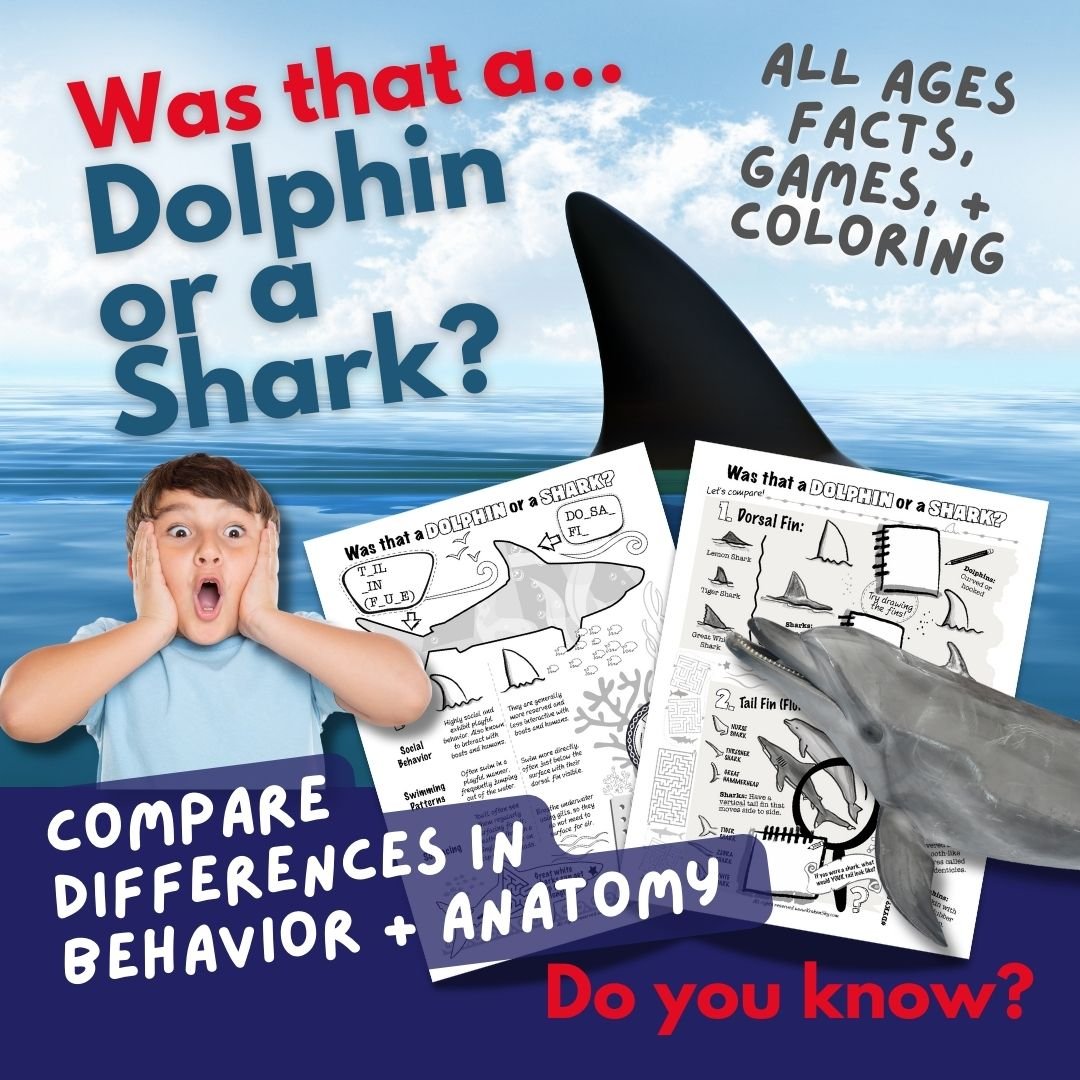
Compare Differences in Behavior + Anatomy
2 Pages, Black and White. Zero Prep!
Can your students tell the difference between a dolphin and a shark? 🦈🐬
This engaging science activity helps learners compare and contrast dolphins and sharks using real-life anatomical and behavioral traits. Students explore fins, tails, skin texture, movement, and breathing methods, while practicing observation, comparison, and classification skills.
Perfect for grades 2–5, this lesson integrates science, literacy, and critical thinking—ideal for ocean units, animal studies, or NGSS-aligned centers.
Includes:
- Visual comparison chart: dolphin vs. shark
- Diagram labeling and drawing prompts
- Fun fact callouts (“Did you know…?”)
- Discussion and critical thinking questions
- Printable classroom or homeschool activity sheet
Suggested Use
- Ocean or marine life science units
- Animal classification and adaptations lessons
- Science centers, bulletin boards, or early finisher activity
- Integrate with nonfiction reading on ocean animals
- Great for Earth Day, Ocean Week, or marine biology themes
Standards AlignmentNGSS (Next Generation Science Standards)
- 3-LS4-3: Construct an argument with evidence that in a particular habitat some organisms can survive well, some less well, and some not at all.
- 4-LS1-1: Construct an argument that animals have internal and external structures that function to support survival, growth, behavior, and reproduction.
- 3-LS3-2: Use evidence to support the explanation that traits can be influenced by the environment.
- 5-LS2-1: Develop a model to describe the movement of matter among plants, animals, decomposers, and the environment.
- (Connects to comparing species’ adaptations and survival traits in marine habitats.)
CCSS (Common Core State Standards for ELA & Literacy)
Reading Informational Text:
- CCSS.ELA-LITERACY.RI.3.7 — Use information gained from illustrations and text to demonstrate understanding.
- CCSS.ELA-LITERACY.RI.4.1 — Refer to details and examples when explaining or inferring.
- CCSS.ELA-LITERACY.RI.4.9 — Integrate information from two texts (or diagrams) on the same topic to write or speak about it knowledgeably.
Writing & Speaking:
- CCSS.ELA-LITERACY.W.4.2 — Write informative texts to examine a topic and convey ideas clearly.
- CCSS.ELA-LITERACY.SL.4.1 — Engage effectively in collaborative discussions on grade-level science topics.