
Life Cycle of a Bee: Facts + Bee History + Games
Life Cycle of a Bee: Facts + Bee History + Games
Discover How Bees Grow – From Egg to Hive Hero!
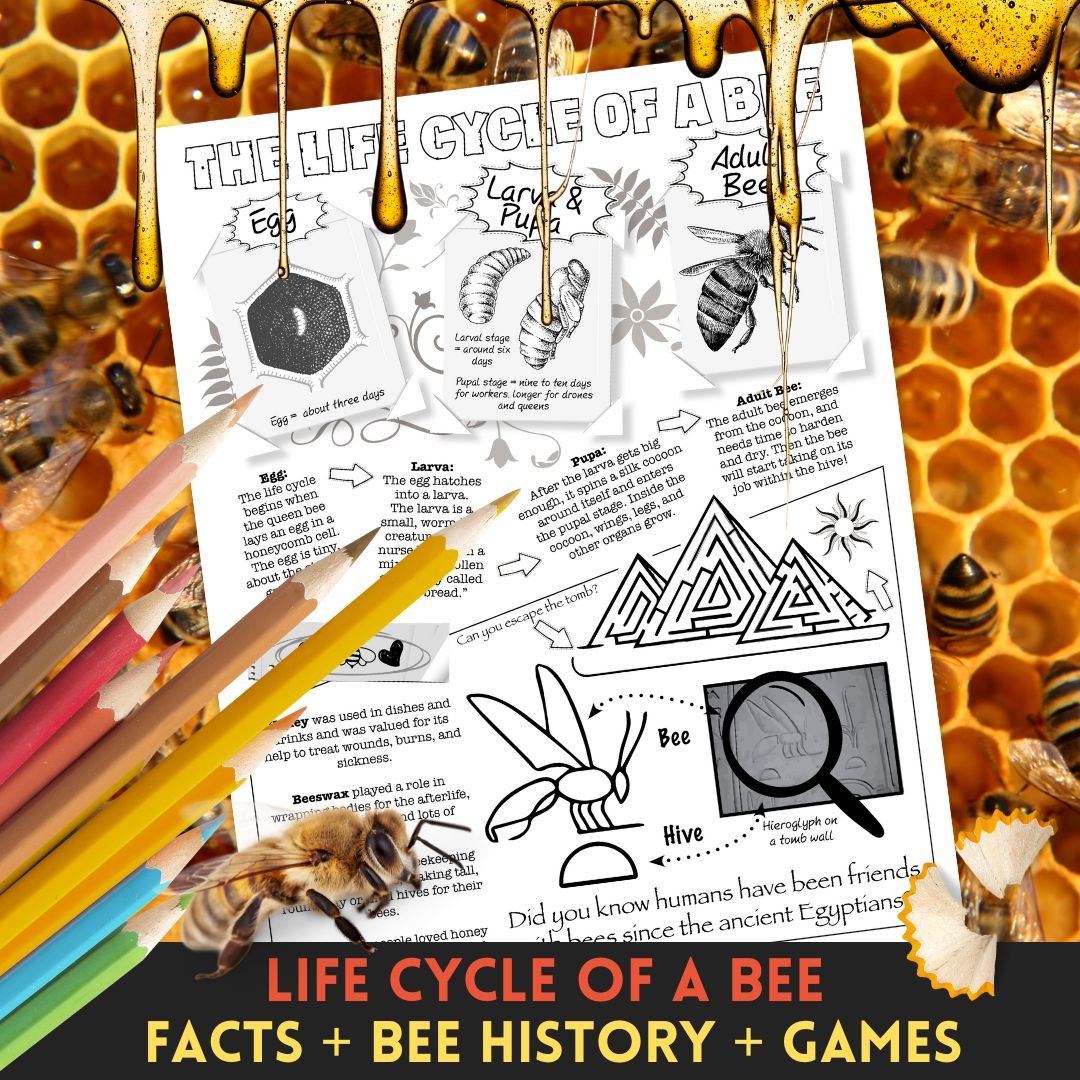
Buzz into biology with this fun, fact-filled activity sheet that explores the life cycle of a bee and dives into the fascinating role bees have played throughout human history! Perfect for curious learners, this printable combines science, history, and hands-on activities that support multiple learning styles.
What’s Inside:
Life Cycle of a Bee – 4 Stages
- Egg – Tiny and delicate, laid by the queen
- Larva – Worm-like and hungry for bee bread
- Pupa – Wrapped in a silk cocoon as it transforms
- Adult Bee – Ready to work and help the hive!
Bonus: Bee History Fun Facts!
- Learn how ancient Egyptians kept bees
- Discover the uses of honey and beeswax in medicine, food, art, and rituals
- Find out how humans and bees have worked together for thousands of years!
Activities Include:
- Coloring Sections – Great for visual and tactile learners
- Maze Game – Reinforces problem-solving and makes it fun
- Illustrated Descriptions – Visuals support comprehension of each life stage
Product Features:
- No Prep – Just print and go
- Black & white – Easy to copy and color
- Standard letter size (8.5" x 11")
- Combines science, history, and art
- Perfect for field trips, classrooms, nature centers, and homeschool
- Encourages independent learning and exploration
- Great for reluctant readers and hands-on learners
- Supports multiple learning styles through gamified education
- Best With: Colored pencils, crayons, or markers
Learning Objectives:
Students will be able to:
- Describe the stages of a bee’s life cycle
- Explain how bees interact with their environment and humans
- Make connections between science and history
- Practice fine motor and problem-solving skills with an interactive maze
Standards Alignment
NGSS – Next Generation Science Standards
- K-LS1-1: Use observations to describe patterns of what plants and animals (including humans) need to survive.
- 1-LS3-1: Make observations to construct an evidence-based account that young plants and animals are like, but not exactly like, their parents.
- 2-LS2-2: Develop a simple model that mimics the function of an animal in dispersing seeds or pollinating plants.
- 3-LS1-1: Develop models to describe that organisms have unique and diverse life cycles but all have birth, growth, reproduction, and death in common.
CCSS – Common Core State Standards (ELA-Literacy)
- RI.1.1 / RI.2.1 / RI.3.1: Ask and answer questions about key details in a text.
- RI.1.4 / RI.2.4 / RI.3.4: Determine the meaning of domain-specific words and phrases in a text.
- RI.1.7 / RI.2.7 / RI.3.7: Use illustrations and details in a text to describe its key ideas.
- L.1.6 / L.2.6 / L.3.6: Use words and phrases acquired through reading and being read to.
Games
- Egg, Larva, Pupa, Adult
- Illustrations and descriptions
- Fun bee history facts
- Maze
- Coloring
From science to storytelling, this engaging handout helps kids understand the incredible journey of bees while sparking curiosity about the past and present role of pollinators in our world!